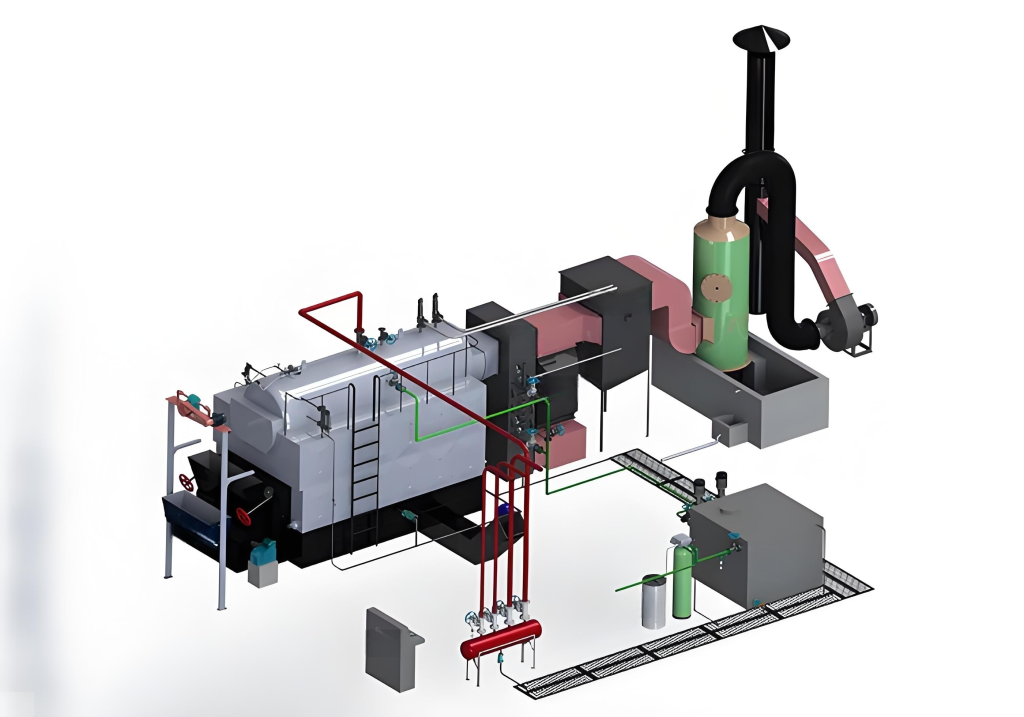
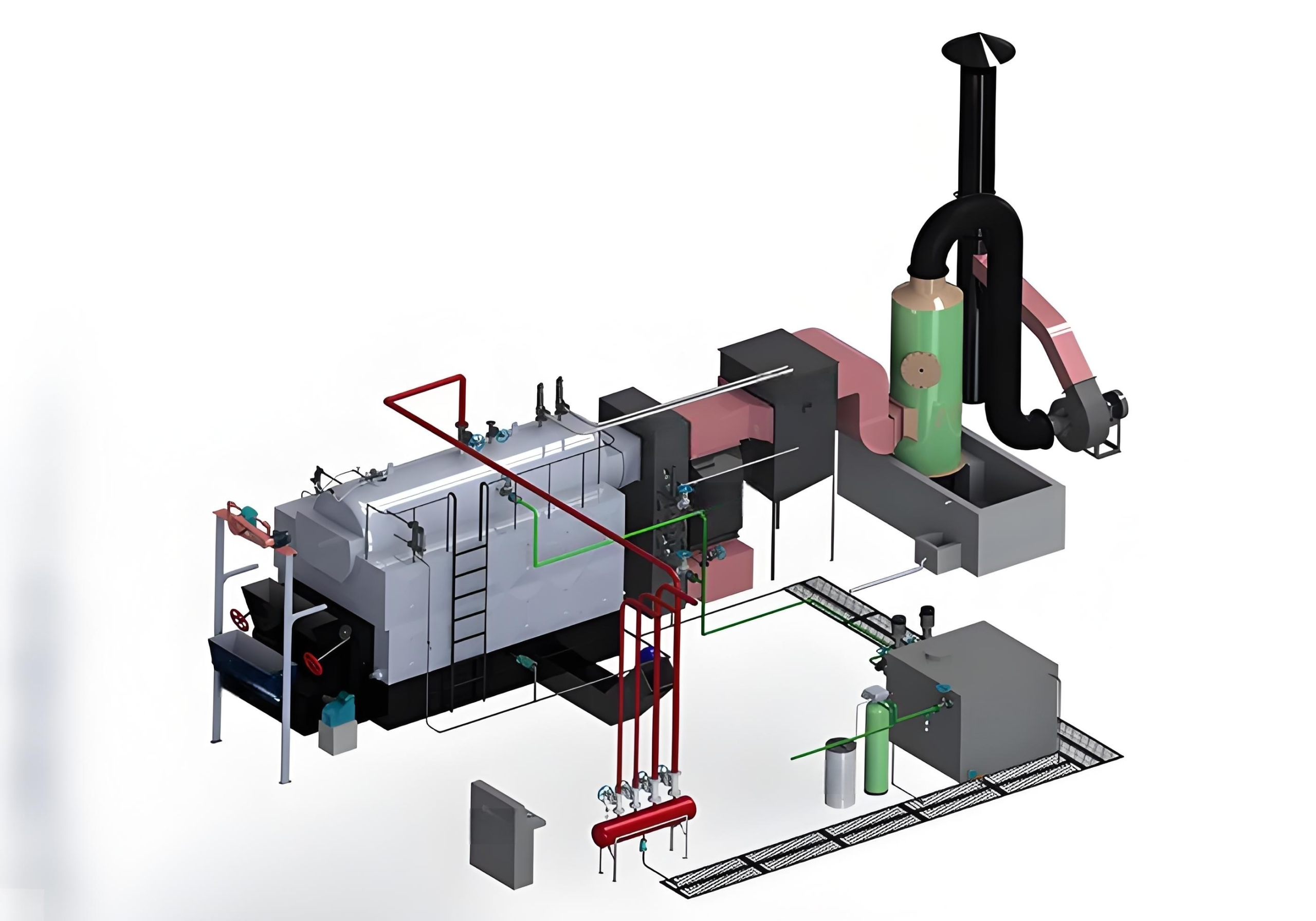
An economizer is the least controversial efficiency upgrade available to a steam plant: it takes heat already leaving through the chimney and puts it into feedwater. Whether it pays depends on stack temperature, fuel sulphur, running hours and how the boiler is actually operated, and those four numbers decide the answer long before a quotation is issued.
Where the fuel energy goes
A well-run shell boiler converts 85 to 90 percent of fuel energy into steam. Of the remainder, stack loss dominates at 8 to 15 percent, with radiation and unburnt losses at 1 to 2 percent. Stack temperature is the visible symptom: 220 to 260 °C on a clean gas-fired unit, 180 to 220 °C on oil, and higher on coal or moist biomass. Each 20 to 22 °C reduction in flue gas temperature recovers roughly 1 percent of fuel input, which is the rule of thumb every feasibility study starts from and a useful cross-check on a detailed calculation.
Worked example for a 10 t/h boiler
Take a 10 t/h gas-fired boiler at 8 bar(g) with 88 percent efficiency, burning 700 kg/h of natural gas. Flue gas flow is about 12,000 kg/h at 230 °C. Cooling it to 150 °C in a feedwater economizer, with a mean specific heat of 1.05 kJ/kg·K:
Q = 12,000 x 1.05 x 80 = 1,008,000 kJ/h, or 280 kW
Fuel input is 7.95 MW, so 280 kW is 3.5 percent of input. Feedwater at 10,000 kg/h rises by about 24 °C, from 20 to 44 °C. Over 6,000 operating hours the saving is around 147,000 m3 of gas; at a typical industrial price the economizer, ductwork, fan changes and controls return their cost in 10 to 18 months. On a coal-fired unit the same hardware often saves more, because stack temperatures are higher, but fouling and corrosion risk rise with it.
Temperature limits are set by corrosion
| Fuel | Minimum flue gas outlet | Reason |
|---|---|---|
| Natural gas | 120-150 °C | Water vapour condensation, weak carbonic acid |
| Light oil and diesel | 150-170 °C | Sulphur trioxide and acid dew point |
| Heavy fuel oil | 160-180 °C | Higher sulphur, vanadium deposits |
| Coal | 150-170 °C | Acid dew point plus ash fouling |
| Biomass and wood | 140-160 °C | Moisture and chloride corrosion |
Condensing economizers can go below 100 °C on gas and recover another 5 to 8 percent, but they need stainless or polymer surfaces, a condensate drain and a genuine use for 40 to 60 °C water. They rarely suit plants without a continuous low-grade hot water demand, and they add a plume that neighbours sometimes notice.
What the retrofit involves
- Space between boiler outlet and chimney, or a bypass arrangement for cold start
- Draft calculation: 0.5 to 1.5 kPa of added resistance, often needing a larger ID fan
- Feedwater route change, bypass valve, drain points and a low-temperature protection logic
- Finned tubes at adequate pitch, with access for soot blowing or water washing
- Insulation and surface protection, since an uninsulated economizer loses much of what it recovers
Verify the saving after installation
A guarantee is only useful if it can be measured. Fit temperature sensors on flue gas in and out and on feedwater in and out, and log them alongside gas or coal consumption for a month before and after the retrofit. The heat balance then shows recovered duty in kW, which is independent of production volume and much more defensible than a comparison of monthly fuel bills. On the example above, the measured duty should land within 10 percent of 280 kW; a larger gap usually means fouling, bypass leakage or a feedwater flow above design. It is also worth logging stack temperature monthly afterwards, because a rising trend is the earliest sign of soot or scale on the gas side.
When an economizer does not pay
Plants running 2,000 hours a year, boilers already fitted with an air preheater, and coal units with 180 °C stacks and heavy fouling see paybacks beyond four years. Very small boilers below 2 t/h often cannot justify the ductwork and fan changes even when the heat balance looks attractive. In those cases, feedwater temperature control, blowdown heat recovery and burner tuning usually deliver more saving per unit of capital, and they can be done without touching the pressure envelope.
XBOILER COMPANY supplies economizers matched to the boiler, burner and fuel, and our engineers check the draft balance before the unit is quoted. The supplying factory can deliver the economizer with the boiler as a single package, which avoids the most common retrofit problem: a heat exchanger that fits the duct but not the existing fan curve.