Most boiler failures blamed on the boiler start in the water. Scale, corrosion and carryover reduce output long before a tube ruptures, and each of them shows on the fuel bill months earlier than on the pressure gauge. A feedwater and blowdown programme is therefore a commercial measure as much as a mechanical one, and it is usually the cheapest efficiency work available to an existing plant.
What untreated water costs
Every millimetre of calcium carbonate scale on a fire-tube furnace adds roughly 2 to 5 percent to fuel consumption, because heat must cross an insulating layer before it reaches water. At 1.5 mm a boiler that once made 10 t/h may only hold its rating with a higher firing rate, and the furnace crown runs at a higher metal temperature, which shortens life. Oxygen at 0.1 mg/L, which a cold unaerated tank can still pass, pits the shell and feed line. Carryover of 1 percent deposits solids in the superheater and contaminates steam used directly in food or textile processes, where the damage appears as rejected product rather than as a repair bill.
Typical water quality targets
| Parameter | Feedwater | Boiler water |
|---|---|---|
| Total hardness | below 0.5 ppm as CaCO3 | effectively zero |
| pH at 25 °C | 8.5-9.5 | 10.5-12 |
| Dissolved oxygen | below 0.02 mg/L after deaeration | not applicable |
| Total dissolved solids | as low as practicable | 3,000-3,500 uS/cm |
| Silica | below 5 mg/L | below 150 mg/L at 10 bar |
| Iron | below 0.1 mg/L | below 1 mg/L |
| Phosphate residual | not applicable | 10-30 ppm |
Limits tighten with pressure: above 25 bar the allowable TDS and silica fall sharply, and a shell boiler rule of thumb no longer applies. The figures above suit fire-tube and small water-tube units between 5 and 20 bar.
The treatment train
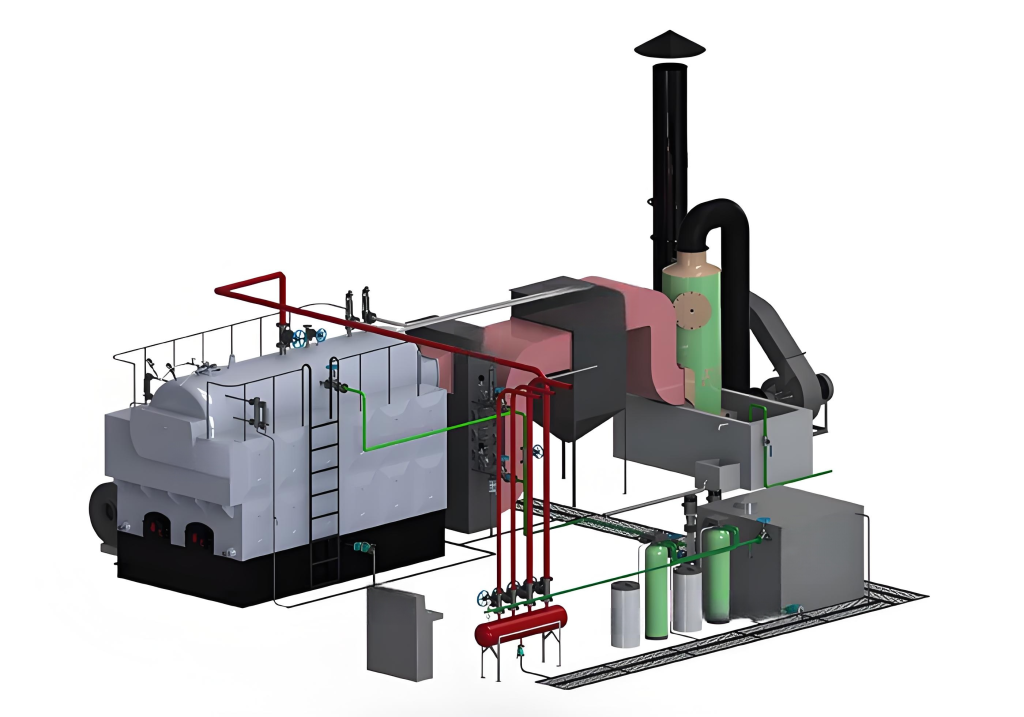
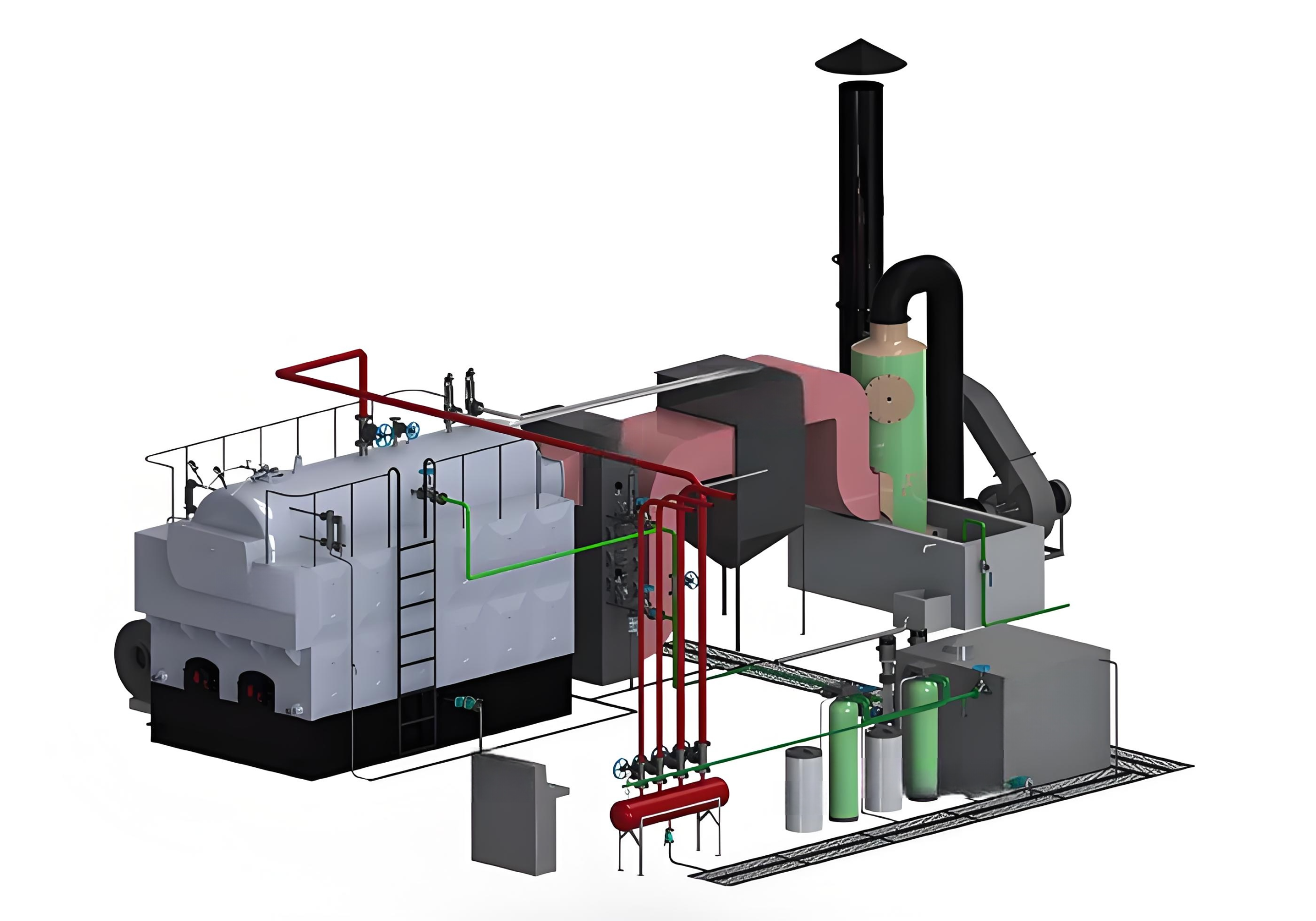
A softener removes hardness by ion exchange and remains the backbone for shell boilers up to about 20 bar. Where raw water alkalinity exceeds 100 ppm, a dealkalizer or reverse osmosis reduces the blowdown demand; RO has become common where discharge limits or a low-blowdown target exist. Deaeration follows, either in a pressurised unit at 105 °C or a vacuum unit at 60 to 80 °C. Chemical dosing closes the gaps: phosphate or polymer for residual hardness, sulphite or DEHA for oxygen scavenging, and an amine blend for condensate line protection. Filming amines need care where steam contacts food, and the chemical supplier should confirm food-contact approval in writing.
Blowdown: how much and how often
Blowdown controls dissolved solids, and two separate operations are involved. Surface blowdown, drawn from the water surface where dissolved solids concentrate, is continuous or near-continuous and is the one that governs chemistry. Bottom blowdown, drawn from the lowest point, removes sludge and is short and intermittent. Confusing the two is a common cause of either scaled tubes or an unnecessary fuel loss.
The required surface blowdown rate follows from a mass balance:
Blowdown percent = TDS feed / (TDS limit – TDS feed) x 100
With feedwater at 300 uS/cm and a 3,000 uS/cm boiler limit, blowdown is about 11 percent of feedwater. That is high enough to justify a dealkalizer or RO rather than simply blowing down more. Automatic surface blowdown on a conductivity controller holds the set point within about 5 percent and replaces manual guessing, which is usually either too little or far too much. Bottom blowdown remains a manual, short, sequenced operation, once or twice a shift, to lift sludge from the mud drum; long bottom blows waste heat and disturb circulation.
Recover the heat you paid for
Blowdown at 10 bar carries roughly 780 kJ/kg. A flash vessel discharging to 1 bar returns about 15 percent of that as low-pressure steam for the deaerator, and a plate exchanger can cool the remainder to 40 °C while heating make-up water. On a 10 t/h boiler with 8 percent blowdown, that is 800 kg/h of hot water and 20 to 40 kW of continuous recovered heat. Payback on a packaged blowdown recovery unit is commonly under two years, and the deaerator benefits twice because its steam demand falls.
Monitoring that prevents failures
- Daily: hardness, conductivity, pH, sulphite residual, blowdown log
- Weekly: oxygen reading after the deaerator, iron in feedwater, condensate pH
- Monthly: scale inspection through handholes, safety valve lift check, dosing pump calibration
- Annually: internal inspection, tube samples, review of treatment against actual blowdown volume
XBOILER COMPANY supplies feedwater treatment packages, deaerators and blowdown heat recovery with steam boiler orders, sized from the water analysis the customer provides. Our engineers specify the train from a full laboratory report rather than a single hardness figure, since alkalinity and silica often decide the configuration more than hardness does.